If you've ever tried to find the best Lean Six Sigma training online, you know the task can be quite daunting. Here are some blog posts I've gathered that I hope help make your search easier:
Lean Six Sigma Green Belt Training anytime, anywhere
Selecting the best online Lean Six Sigma training provider
Additionally, Lean Six Sigma training give you a competitive advantage.
Thursday, July 5, 2012
Wednesday, March 28, 2012
Analyze, Improve & Control: Lean Six Sigma
Lean Six Sigma's Third Phase: Analyze
What is your data indicating to you? This phase is often interwoven with the Measure Phase. While information is gathered, the team might consist of differing people which will collect different sets of data or additional data. While the team reviews the data gathered throughout the Measure Phase, some may choose to alter the information collection method to incorporate added information. This continues while the team analyzes the information along with the process so that you can focus on and substantiate the root reasons of waste and problems.
Closely investigate the process
Subsequent to putting together, validating and examining detailed process maps created in the Measure Phase, the group has the ability to list problems or pain issues while in the process. This permits the group to reap the benefits of the collected knowledge of process members. Subsequently, the team can determine the value of every single stage by conducting “Process Analysis” which includes:
“Time Analysis“: concentrates on the actual time work being done in the process in compared to time that is wasted hanging around. The interesting thing teams find out is that whereas people are 99% busy, “things” are 99% not doing anything.
“Value Added Analysis“: contributes one more aspect of discovery by examining the process via the viewpoint of the customer to discover the expense of doing business.
“Value Stream Mapping”: integrates process data with a map of the value-adding steps to help determine where Waste can be removed.
Visually inspect the data
After collecting the data, the group has the ability to exhibit the data by using charts and graphs for visual indicators for issues from the process. The alteration of numbers into images permits the group to effortlessly communicate their results to leadership and additional process members.
Brainstorm possible source(s) of the issue
Teams can formulate hypotheses around likely reasons behind the problem by thinking jointly. Using a tool known as the “Cause & Effect Diagram“, the groups are able to carry out ordered brainstorming that can help them pin down the critical few factors behind missing time, defects and waste in the process.
Validate the source(s) of the problem
Ahead of moving to the subsequent phase (known as Improve), the team needs to affirm the proposed root cause is the cause of the problem by verifying their data thru process examination, data analysis, process observation and comparative investigation.
Update your Project Charter
Once your team has more deeply looked at the information, they'll possess extra detail about process effectiveness and the prospects for improvement. The group can revise their Charter while using supplemental information so they possess a more accurate reflection of the undertaking status.
Improve - Phase 4 of 5 of Lean Six Sigma
How do you correct the issue? As soon as the project groups are happy with the data and have established that more analysis isn't going to increase their comprehension of the issue, it’s time for you to start working on developing a solution. The team is probably collecting improvement recommendations all through the project, but a structured improvement effort can bring about resourceful and exceptional answers.
Discuss solutions which could take care of the issue
The team's endeavors at this stage will be to generate as many ideas as they possibly can as per the idea that through Quantity, comes Quality. Imaginative idea generating is made of a bunch of methods developed to lead the team to out-of-the-box answers.
Choose the pragmatic remedies
Many times, a project team can utilize a list of upgrades to their processes, however when they're expected to pick amongst conflicting options, you can find resources which include the “Weighted Criteria Matrix”, which will help your team to make the perfect decision.
Formulate maps of processes depending on diverse answers
With answers in mind to lessen rework loops, waste and wait times, the group may draw an improved map of the process, also referred to as “To-Be Maps.” These new maps are handy in driving the group's efforts toward the new process, and will be part of a guide for new staff when they are trained with the new process.
Pick the very best solution(s)
To guarantee the perfect choice is made, the team could employ mini assessment cycles known as “PDCA” or Plan Do Check Act, that can help perfect the recommendations whilst acquiring invaluable stakeholder feedback. These rounds are a good way to determine if small enhancements are practical in a prompt and low impact manner.
Implement the solution(s)
Carrying out successful execution calls for meticulous planning. The team ought to give some thought to logistics, coaching, paperwork and communicating plans. The more time the team invests on planning, the quicker they accomplish complete adaptation to the enhancements by their process contributors.
Measure improvement
The moment the team can show that the remedy has lead to quantifiable progression, consequently the group can go forward to the Control Phase.
Control: Lean Six Sigma Phase 5/5
How can you support the latest achieved improvement? This phase is a stripped-down version of process management. The group has been setting up a form of infrastructure through the entire life of the project, and for the Control Phase they start to document just how they wish to forward that arrangement to the employees who work inside of the process.
Endlessly improve the process working with Lean standards
The four principles of Value, Flow, Pull and Perfection should continue being a relentless focus for each and every business. While Continuous Improvement teams provide the outcomes for each project, they have to push for efforts to convey this concentration to the personnel using the recently improved process. The process can invariably be improved upon.
Value: Figure out what actions are necessary (are of “Value”) to your consumer
Flow: Eliminate Waste within the system to maximize the process to attain a smoother stride
Pull: Be sure that the process corresponds to to consumer wants (“Pull” = want)
Perfection: Continually focus on “Perfection” in the process.
Be sure the process has been supervised and watched accordingly
In an effort to keep this focus, the team really should focus on the important few measurements they need to sustain for regular monitoring of the processes performance. This observation is accompanied by a reaction plan specifying the thresholds at which the process should preferably run and what to do in the case the process should exceed those ranges. This could result in sustained process refinement.
Expand the enhanced process all over the organization
At this juncture, they will need to update records: process maps, document check lists, cheat sheets, etcetera. The more appropriate the ultimate documentation, the less painful things will be for process contributors to adopt the new way of accomplishing duties.
Apply new knowledge to similar processes in the business
One of the ways to add to the performance and value of Lean Six Sigma efforts is to use the benefits from one project into other places contained in the company. This transmission of improvement techniques may come from substantial and smaller initiatives but easily multiplies the impression for every company.
Distribute and enjoy your results
The imparting of project accomplishments brings about superior energy of change in the organization. Even when the project will not be utilized in other areas, there may be parts of it that could be tailored and shared. The advertising and publicizing of each individual success adds to the rate by which upcoming gains can be fleshed out. Lean Six Sigma success drives even more accomplishment.
What is your data indicating to you? This phase is often interwoven with the Measure Phase. While information is gathered, the team might consist of differing people which will collect different sets of data or additional data. While the team reviews the data gathered throughout the Measure Phase, some may choose to alter the information collection method to incorporate added information. This continues while the team analyzes the information along with the process so that you can focus on and substantiate the root reasons of waste and problems.
Closely investigate the process
Subsequent to putting together, validating and examining detailed process maps created in the Measure Phase, the group has the ability to list problems or pain issues while in the process. This permits the group to reap the benefits of the collected knowledge of process members. Subsequently, the team can determine the value of every single stage by conducting “Process Analysis” which includes:
“Time Analysis“: concentrates on the actual time work being done in the process in compared to time that is wasted hanging around. The interesting thing teams find out is that whereas people are 99% busy, “things” are 99% not doing anything.
“Value Added Analysis“: contributes one more aspect of discovery by examining the process via the viewpoint of the customer to discover the expense of doing business.
“Value Stream Mapping”: integrates process data with a map of the value-adding steps to help determine where Waste can be removed.
Visually inspect the data
After collecting the data, the group has the ability to exhibit the data by using charts and graphs for visual indicators for issues from the process. The alteration of numbers into images permits the group to effortlessly communicate their results to leadership and additional process members.
Brainstorm possible source(s) of the issue
Teams can formulate hypotheses around likely reasons behind the problem by thinking jointly. Using a tool known as the “Cause & Effect Diagram“, the groups are able to carry out ordered brainstorming that can help them pin down the critical few factors behind missing time, defects and waste in the process.
Validate the source(s) of the problem
Ahead of moving to the subsequent phase (known as Improve), the team needs to affirm the proposed root cause is the cause of the problem by verifying their data thru process examination, data analysis, process observation and comparative investigation.
Update your Project Charter
Once your team has more deeply looked at the information, they'll possess extra detail about process effectiveness and the prospects for improvement. The group can revise their Charter while using supplemental information so they possess a more accurate reflection of the undertaking status.
Improve - Phase 4 of 5 of Lean Six Sigma
How do you correct the issue? As soon as the project groups are happy with the data and have established that more analysis isn't going to increase their comprehension of the issue, it’s time for you to start working on developing a solution. The team is probably collecting improvement recommendations all through the project, but a structured improvement effort can bring about resourceful and exceptional answers.
Discuss solutions which could take care of the issue
The team's endeavors at this stage will be to generate as many ideas as they possibly can as per the idea that through Quantity, comes Quality. Imaginative idea generating is made of a bunch of methods developed to lead the team to out-of-the-box answers.
Choose the pragmatic remedies
Many times, a project team can utilize a list of upgrades to their processes, however when they're expected to pick amongst conflicting options, you can find resources which include the “Weighted Criteria Matrix”, which will help your team to make the perfect decision.
Formulate maps of processes depending on diverse answers
With answers in mind to lessen rework loops, waste and wait times, the group may draw an improved map of the process, also referred to as “To-Be Maps.” These new maps are handy in driving the group's efforts toward the new process, and will be part of a guide for new staff when they are trained with the new process.
Pick the very best solution(s)
To guarantee the perfect choice is made, the team could employ mini assessment cycles known as “PDCA” or Plan Do Check Act, that can help perfect the recommendations whilst acquiring invaluable stakeholder feedback. These rounds are a good way to determine if small enhancements are practical in a prompt and low impact manner.
Implement the solution(s)
Carrying out successful execution calls for meticulous planning. The team ought to give some thought to logistics, coaching, paperwork and communicating plans. The more time the team invests on planning, the quicker they accomplish complete adaptation to the enhancements by their process contributors.
Measure improvement
The moment the team can show that the remedy has lead to quantifiable progression, consequently the group can go forward to the Control Phase.
Control: Lean Six Sigma Phase 5/5
How can you support the latest achieved improvement? This phase is a stripped-down version of process management. The group has been setting up a form of infrastructure through the entire life of the project, and for the Control Phase they start to document just how they wish to forward that arrangement to the employees who work inside of the process.
Endlessly improve the process working with Lean standards
The four principles of Value, Flow, Pull and Perfection should continue being a relentless focus for each and every business. While Continuous Improvement teams provide the outcomes for each project, they have to push for efforts to convey this concentration to the personnel using the recently improved process. The process can invariably be improved upon.
Value: Figure out what actions are necessary (are of “Value”) to your consumer
Flow: Eliminate Waste within the system to maximize the process to attain a smoother stride
Pull: Be sure that the process corresponds to to consumer wants (“Pull” = want)
Perfection: Continually focus on “Perfection” in the process.
Be sure the process has been supervised and watched accordingly
In an effort to keep this focus, the team really should focus on the important few measurements they need to sustain for regular monitoring of the processes performance. This observation is accompanied by a reaction plan specifying the thresholds at which the process should preferably run and what to do in the case the process should exceed those ranges. This could result in sustained process refinement.
Expand the enhanced process all over the organization
At this juncture, they will need to update records: process maps, document check lists, cheat sheets, etcetera. The more appropriate the ultimate documentation, the less painful things will be for process contributors to adopt the new way of accomplishing duties.
Apply new knowledge to similar processes in the business
One of the ways to add to the performance and value of Lean Six Sigma efforts is to use the benefits from one project into other places contained in the company. This transmission of improvement techniques may come from substantial and smaller initiatives but easily multiplies the impression for every company.
Distribute and enjoy your results
The imparting of project accomplishments brings about superior energy of change in the organization. Even when the project will not be utilized in other areas, there may be parts of it that could be tailored and shared. The advertising and publicizing of each individual success adds to the rate by which upcoming gains can be fleshed out. Lean Six Sigma success drives even more accomplishment.

Friday, March 23, 2012
The Best Lean Six Sigma Simulation
Gaining buy-in for Lean Six Sigma can be quite difficult, especially is stakeholders don't truly understand its benefits.
Now, you can painlessly introduce the core concepts of Lean Six Sigma using a Lean Six Sigma Simulation. The Simulation is a one day workshop that provides a lively, engaging, and fun atmosphere to a typically classroom-oriented process. Participants will will have separate roles where they'll be able to understand how the DMAIC process and Lean Six Sigma can work effectively within their organizations.
Now, you can painlessly introduce the core concepts of Lean Six Sigma using a Lean Six Sigma Simulation. The Simulation is a one day workshop that provides a lively, engaging, and fun atmosphere to a typically classroom-oriented process. Participants will will have separate roles where they'll be able to understand how the DMAIC process and Lean Six Sigma can work effectively within their organizations.
Sunday, February 26, 2012
Lean Six Sigma's Roots and its Advantages for Healthcare
Lean, though it found its roots in a manufacturing environment, has proved particularly adaptable to service-based organisations and industries like health care. At the core of Lean is a focus on the Customer. Lean endeavors to have the organisation function on the strategy of continually bettering value to a customer.
Generally Lean Six Sigma is accurately identified with removing the various types of waste within processes that ordinarily are not productive and non-value adding, yet Lean should not be regarded as merely a tactic or process to decrease costs; rather it's a method of thinking strategically about the processes that constitute the organization and the way they take care of the customer’s needs.
Lean Six Sigma’s Roots and Progression into Health care
Lean in healthcare should not be discussed without first acknowledging the background from which the concept of “Lean” comes about - organizational/process improvement techniques. The modern history of improvement methodologies can be followed back to Eli Whitney and the Cotton Gin with its interchangeable parts, to Henry Ford and his just in time auto manufacturing strategy, and Alfred P. Sloan at General Motors. Each individual made contributions and refined the concepts and methodologies that made it possible for manufacturers to give a product that is valuable to a customer. Other key events included early time and motion scientific studies by Frederick Taylor, human motivation and attitude studies by Frank and Lillian Gilbreth, and applied statistics from W. Edwards Deming. Deming’s research contributed deeply to Toyota's Production System, which is where Lean principles were formulated. Further learning and innovations to organizational effectiveness are present in Zero Defects, Quality Circles, Total Quality Management, and Business Process Reengineering, and others.
Lean has helped force a reevaluation of who the customer actually is in health care. Not surprisingly common sense says the customer is the patient, but if we examine the myriad of very complicated processes available and the problems health care organizations and providers face, you realize that quite often the patient is more at the effect of the system than the beneficiary of a satisfying experience. Thankfully, some healthcare organizations have reoriented themselves into becoming genuinely patient-focused and by making use of lean principles, are leading to fantastic enhancements in productivity, cost reductions, patient flow, patient safety and quality, inventory and space needs, and best of all, overall patient outcomes.
The elemental concept of Lean Six Sigma is to get rid of the “8 Wastes” seen among all organizations.
Often in the healthcare industry, services can take a remarkably roundabout path in getting delivered to the customer. Processes are frequently made up of “work arounds” that were used because they compensated for a particular failure at a specific point in time - and it became part of “the way it's done around here.” As processes become more elaborate, they usually tend to end up being even further away from the customer, and there are more handoffs and errors. The challenge that Lean asks is: “Is there another way to go from here to there?” By understanding the 8 Wastes and how they show up in healthcare environments, organizational leaders can get started reviewing the processes as part of the entire service driven by the “pull” of the customer, and can begin to optimize the value stream that delivers on an organization’s guarantees.
Lean’s Significant Advantage to Health care and its Leaders
Lean offers excellent power to health care leaders to manage the ongoing escalation in costs due to wasteful methods and by providing best practices and standard methods of doing work in various environments. There are essential concepts in Lean Thinking that we will explore in forthcoming articles. As based on the Institute for Healthcare Improvement, essential areas that should be addressed:
Leadership: Implementing the changes to use Lean Thinking aren't for those who are faint of heart. It cannot be achieved piecemeal, but must be a whole system strategy.
Process: An ideal process creates exactly the ideal amount of value for the customer. Each step provides value, leads to a good result each time, produces the desired output every time, will not cause delay, is flexible and associated by a continuous flow.
Culture: Expecting people to discover waste in the work they're doing and are invested in is problematic; it entails clear vision and unwavering leadership dedication as the values and beliefs change so that an innovative “lean” culture can emerge.
Learn more about why leadership is critical to Lean Six Sigma Healthcare.
Generally Lean Six Sigma is accurately identified with removing the various types of waste within processes that ordinarily are not productive and non-value adding, yet Lean should not be regarded as merely a tactic or process to decrease costs; rather it's a method of thinking strategically about the processes that constitute the organization and the way they take care of the customer’s needs.
Lean Six Sigma’s Roots and Progression into Health care
Lean in healthcare should not be discussed without first acknowledging the background from which the concept of “Lean” comes about - organizational/process improvement techniques. The modern history of improvement methodologies can be followed back to Eli Whitney and the Cotton Gin with its interchangeable parts, to Henry Ford and his just in time auto manufacturing strategy, and Alfred P. Sloan at General Motors. Each individual made contributions and refined the concepts and methodologies that made it possible for manufacturers to give a product that is valuable to a customer. Other key events included early time and motion scientific studies by Frederick Taylor, human motivation and attitude studies by Frank and Lillian Gilbreth, and applied statistics from W. Edwards Deming. Deming’s research contributed deeply to Toyota's Production System, which is where Lean principles were formulated. Further learning and innovations to organizational effectiveness are present in Zero Defects, Quality Circles, Total Quality Management, and Business Process Reengineering, and others.
Lean has helped force a reevaluation of who the customer actually is in health care. Not surprisingly common sense says the customer is the patient, but if we examine the myriad of very complicated processes available and the problems health care organizations and providers face, you realize that quite often the patient is more at the effect of the system than the beneficiary of a satisfying experience. Thankfully, some healthcare organizations have reoriented themselves into becoming genuinely patient-focused and by making use of lean principles, are leading to fantastic enhancements in productivity, cost reductions, patient flow, patient safety and quality, inventory and space needs, and best of all, overall patient outcomes.
The elemental concept of Lean Six Sigma is to get rid of the “8 Wastes” seen among all organizations.
Often in the healthcare industry, services can take a remarkably roundabout path in getting delivered to the customer. Processes are frequently made up of “work arounds” that were used because they compensated for a particular failure at a specific point in time - and it became part of “the way it's done around here.” As processes become more elaborate, they usually tend to end up being even further away from the customer, and there are more handoffs and errors. The challenge that Lean asks is: “Is there another way to go from here to there?” By understanding the 8 Wastes and how they show up in healthcare environments, organizational leaders can get started reviewing the processes as part of the entire service driven by the “pull” of the customer, and can begin to optimize the value stream that delivers on an organization’s guarantees.
Lean’s Significant Advantage to Health care and its Leaders
Lean offers excellent power to health care leaders to manage the ongoing escalation in costs due to wasteful methods and by providing best practices and standard methods of doing work in various environments. There are essential concepts in Lean Thinking that we will explore in forthcoming articles. As based on the Institute for Healthcare Improvement, essential areas that should be addressed:
Leadership: Implementing the changes to use Lean Thinking aren't for those who are faint of heart. It cannot be achieved piecemeal, but must be a whole system strategy.
Process: An ideal process creates exactly the ideal amount of value for the customer. Each step provides value, leads to a good result each time, produces the desired output every time, will not cause delay, is flexible and associated by a continuous flow.
Culture: Expecting people to discover waste in the work they're doing and are invested in is problematic; it entails clear vision and unwavering leadership dedication as the values and beliefs change so that an innovative “lean” culture can emerge.
Learn more about why leadership is critical to Lean Six Sigma Healthcare.
Friday, February 24, 2012
What is Lean?
The difficulty with the Internet is that there are so many resources out there that many managers, executives and other professionals have trouble finding high quality, clear, credible pieces of information.
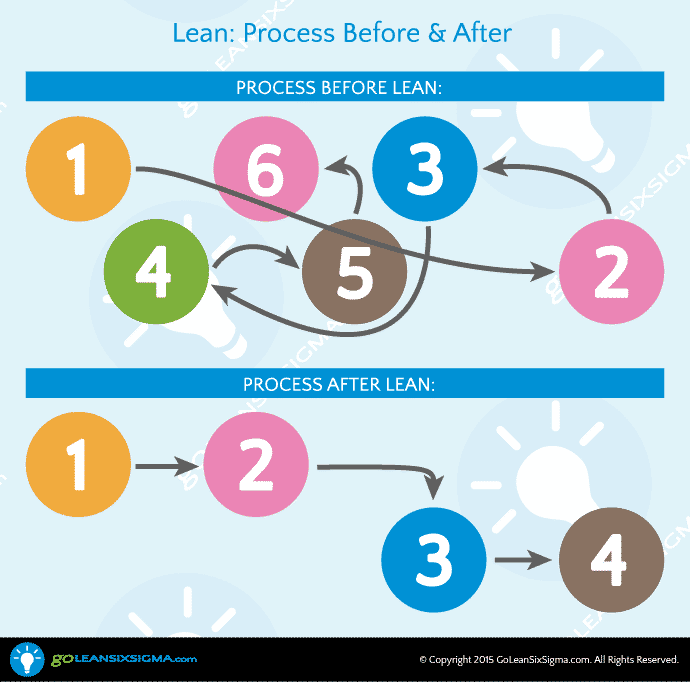
Fortunately, they do exist. Here is a graphic that explains what Lean is without using jargon or other technical terms that just don't add value to someone simply interested in learning about Lean or Six Sigma.

Fortunately, they do exist. Here is a graphic that explains what Lean is without using jargon or other technical terms that just don't add value to someone simply interested in learning about Lean or Six Sigma.
Subscribe to:
Comments (Atom)